Friday, September 18, 2015

An Evening Ride

Thanks to everyone who commiserated with me about my super first world problem of my body being sore after working at a desk for a couple weeks (and massive shout out to JenJ who sent me an email with some great advice!). I saw the doctor this morning and it went really well. I'm getting PT for my shoulder and got an x-ray and a wrist brace today for my wrist. No diagnosis yet but I'm hoping they'll figure it out and fix me up.

Today I'm working from home so I've been wandering around my house while working. Definitely helping my office-induced-pain. Not helping my productivity levels.

Fingers crossed (well, not now because I now have a cumbersome
wrist brace) that something shows up
Thursday after leaving work a bit too late to really beat any sort of traffic on my way to TC, I eventually made it to the barn. But it was starting to get dark when I got on so I thought it'd be an interesting ride. He's had two days off and I'm making sure that he's being fed most days I'm not able to so he's feeling (and looking, though I'm biased, it's probably too soon to tell) better.

He made me so happy as I got there by whinnying at me as I stepped out of the car. Then he whinnied about five more times as I was bringing stuff in. He came right up to me in pasture and was all cuddly and nuzzley. So sweet!

We got into the arena and went right to work. He was really great to the right and a little crooked to the left, which was odd. He was way over his right shoulder and kind of hard to steer. That usually happens to the right. It's like his right shoulder finally made a bid for freedom and was out of there.

What a country bumpkin, I miss this pony
Because of that, he was feeling resistant on the left rein. I immediately diagnosed it as being caused by not stepping into the left rein vs not bending. This is evidence of major improvement in my riding over the last three years. Rico did the same thing for years and I would just pull on the left rein- it took about fifty lessons to eliminate that behavior.  Instead of pulling as I would have done, I just pushed him up to the left rein and he immediately softened.

We did our normal walk halt transitions off the seat and TC thought that he'd add a special move to that, which included absolutely yanking the rein out of my hand. He got a talking to about that. I took back on one rein to break that up, kicked him with the same leg, and said "QUIT!" But he was pretty sure that he had to yank the rein out of my hand during downward transitions so we actually had a longer discussion than we normally would have. I think he's getting a little full of himself!

By the end of our discussion, he was quite good about it. That plus a bunch of leg yields at walk and trot got him in that super light connection again. I love that place. We did a ton of changes of direction and some spiraling in and out. He's just seamless like that.

 Not such a bad place to be at night

The one thing that he was wanting to do more than usual was to charge off. I think he was just amped because by this point, it was getting dark. He actually SPOOKED at something! I had to try really hard not to pull on him.

I keep forgetting to take credit for this horse. Like he's trained. I need to trust in my training process. Because all I wanted to do was grab his face. But he's TRAINED. So I resisted the face-grabbing urge and I half halted with my seat. And he sat right down, stopped charging, and lightened his front end. Boom. Trained horse. Need to remember that. He may feel green and out of control, but if I don't ride him like he's trained, he'll never be trained.

The canter was downright good. He was round both directions, wasn't struggling with steering as much as usual, and I was able to help him balance a lot better. I tend to get tight in my hip flexors at the canter but I was able to really relax into it in both directions. Poor TC picked up the wrong lead twice going left and he started getting really frustrated about it (I wasn't helping by tipping, ugh). He'd come back to trot, immediately start rushing and trying to canter again. I had to do a lot of transitions within the trot (and make sure I wasn't getting rigid in my arms again) to keep a lid on him. There's definitely a lot of power in this little horse...

Noms in the dark

We ended with some great trot work again, he's struggling to stay with me after the canter. All he wants to do is charge around, I think due to the adrenaline rush, since it doesn't feel all that unbalanced. Or maybe he is really unbalanced and I'm just off in what I'm feeling. I wanted to get some help on that eventually. But after some transitions, we got our good trot back and ended.

Poor horse then had to get fed in the dark because it was almost 8:00 by that point. Oh well, he better get used to it and I need to as well.

This weekend I'm just going to ride and generally going to just try to stay away from desks and computer screens. I briefly considered driving north to watch CDS Champs, which is in Sacramento, but the idea of sitting for a long time in the car isn't very fun. Next year it's in LA, so maybe I'll be able to go the following year... perhaps on TC!

Wednesday, September 16, 2015

Productive Lateral Work

I managed to drag myself down to the barn after work on Monday to see the TC. It was an hour and a half drive from work, which honestly isn't bad for an afternoon commute (I left around 3:30), even if waze took me a weird way. By 5:00ish, I was in town, changing into my riding clothes (I really should do that at work), and heading to TC.

When we got to the arena, I noticed that one of the horses in the paddocks right next to the arena had a new toy. It is basically a heavy duty bobo doll (I dunno what else you call them #banduraftw). I saw it before TC did and wondered how this was going to go (although I do think that he would want one, gotta look that up). It was cold and windy, our first cold and windy day in a LONG time- remember how it was in the 100s last week. Not so much anymore.

I still can't get over these pictures, they're taking me forever
to edit because I'm insisting on editing all of them. 

He is so good
TC saw it and basically melted into the ground. He did that the other day when I was closing my car's hatchback while holding him. He slowly lowers himself to the ground and arches his neck, snorting. I think it's kind of adorable. I like that his first move isn't to get away from scary things.

I was still leading him so I led him up to it and he was pretty nervous. So that plus the wind and the cold made me think that he was going to be a jerk. That's what Rico would do- use the toy as an excuse to spook in that corner or to buck because he was feeling up due to the weather. Jerk!

But TC isn't that horse, there isn't this gotta-get-out-of-work mentality in him that was so strong in Rico. He doesn't make excuses. So we walked around and he kept an eye on the toy. I let him look at first, then slowly insisted that he focus on me. He did. And he never wavered. Even when he was tired or being tapped with the whip to keep cantering, he kept his nose down and did his work. Sure he glanced at it every now and then, but there was no tension or resistance. Just curiosity. I just love that about this horse. He's going to be bombproof I think.

And cute!
Hahaha sometimes trot transitions are hard
The ride went super well. He's still a little resistant to connecting in the beginning. I know I need to stop expecting him to be Rico, who comes out completely through (and then it goes downhill haha). So I did a lot of walking on circles and diagonals and figure-8s to get him more supple and better connected. I also did some halt transitions completely off my seat and MAN is it hard to not touch the rein in those (normally I think we're good at these, but I think after the GHC clinic, I'm insisting on even less rein). I haven't added in light taps with the whip yet to get him to stay engaged and too square up (our winter project), he is going to be confused.

We then trotted a bit. It definitely helps him to get trotting and stay trotting until he's really connected. Lots of circles and diagonals, just making sure that when I use my leg to push him into the outside rein, he goes, that when I half halt with my seat, he sits down a little. I worked the connection lighter and lighter until we got toward that electric connection.

I wish I would look up, and stop slouching, and get my hands even
But hot damn that outside hind leg is great!

He's so sproingy
I wanted to do lateral work for suppleness and not just for the sake of doing it, as I usually do. For a horse who struggles with straightness due to not being responsive enough to the lateral aids and the half halt on the outside rein, I've really been neglecting a key part of fixing this: lateral work. Sure we do leg yields, but I've been treating them like they're tricks. I definitely do that sometimes with movements (did it with the canter too), I'm not sure why, it's helping no one.

We started in walk doing turns on the forehand, working to get him lighter and rounder within the turn, and as always, more responsive laterally. That's hard, so we're going to do that during every ride again. Then we worked on the leg yield, focusing on the steepness and that he will step over to the outside rein and focusing less on the straightness. That's hard for me, to throw away straightness. But it definitely paid off.

We did the same thing in trot- steep leg yields focusing on pushing him TO the outside rein rather than bringing the rein to him and blocking the shoulder. After a few times in each direction, I switched gears and started him crooked, then slowly rode him straight. It worked REALLY well.

Ahhh I love him

Once back at the normal trot, I had this incredibly loose horse who was connected on the lightest, steadiest contact I've felt on him. So light and steady that I was the one fucking it up. It takes so much more balance to ride with that kind of contact, not that I use the connection to balance, but there's something very steadying about a heavier connection (not too heavy though). This felt more fragile. He was just so ON that if I even was off balance one tiny bit, he'd respond to it as if it were an aid. He can't really filter out what I don't want like Rico could (who takes any and all opportunities to ignore his rider anyway).

The canter was pretty good, we're still plugging away at the connection. He was better connected to the left than usual, and the right was great but he's struggling to stay upright and not fall out over that left shoulder.

Overall, I was SO pleased, not least because he totally ignored that toy that he was so spooked about, but also because he just tries so hard and is so fun. I love riding that damn horse.

Pets for the derpiest pony

Switching gears, you guys should have seen my face last night. I went to drop off my board deposit at the new barn (woohoo!) and had texted my old trainer to see if I could come hang out and watch her lessons at the barn up the street. So I did that. And then she said "do you want to help me put passage on a Grand Prix horse?" And my face. It was excited.

Probably like this
It's actually really convenient for both of us. She needs to be on the ground to help him learn with the bamboo but she needs someone ON him who knows what passage feels like and how to ask for it. Enter: Megan, who put passage on a green horse just a couple years ago! Apparently we did a good job since I was bribed with her coming to teach me on TC if I helped her out some more. It just feels good to ride some fucking awesome piaffe, and we did get the passage a little more cadenced.

So fun. Love dressage.

Monday, September 14, 2015

Revisiting Past Issues

I went down to see TC on Friday and then ended up just sitting in my parents' glorious air conditioned house until it got dark. It had been in the 100s again and I was not enthused about going outside. Woops. But I was staying the night anyway so whatever.

Saturday morning I got up and ahhh it was so nice and cool! I got to the barn around 9, which was later than I had hoped but boy is it nice to sleep in a place that is completely and utterly quiet and dark.

I got TC a halter on Friday after work. There's a ridiculously cool tack store about ten minutes from my house. Dangerous. I managed to only buy a "training stick" which is basically a knock off carrot stick (although I do not do Parelli)- TC really respects those vs regular whips, so I thought it'd be handy for ground work and such. I also bought a halter and lead rope. It's super cute, a navy and silver halter with a silver lead rope. He looked pretty dashing in it, but my phone ran out of battery so no picture.

Slowly managing to get through these pictures

He can be so uphill sometimes

Unfortunately TC isn't looking too great. He's dropped some weight since I'm only able to get over there a couple times per week so he only gets his extra food on those days (he gets a flake of hay + rice bran after rides). His lower back didn't look great, since he's losing muscle from not being ridden. I started feeling really guilty, he has really lost a fair amount even in the last few days.

BUT then someone told me that a new horse had been put in their pasture for a couple of days, then promptly taken out because all of the horses were running around too much. So TC, who normally just wanders around quietly, was trotting and cantering around like an idiot for two days straight, without getting extra hay/grain to make up the lost calories. So that explains the sudden drop in weight and probably loss of muscle

My mom offered to feed him on Sunday, which is so nice of her, and I'm riding him hopefully today and then maybe one or two more times this week if I can swing it. I can't wait to get him up here so I can feed him enough and get him working well. Boarding situation is probably going to work (post on that later) but I can't move him until October 1st.

The left lead is so hard and therefore so awkward

He tries but he's still just kind of being held like this

For our ride, it was like we went through a sped up version of the last nine months. I got on him and he was spooky and lazy, not really steering, just generally regressing to his 3 year old year. He was so distracted by everything. Now, he's four, so it's not like he's always focused, but he doesn't usually look at normal activity outside the arena. Like a man walking by. But that man was SO interesting on Friday.

Then we went through the retraction in the neck phase. That was fun to revisit as I suddenly had no horse in the contact. I tried to push him out to the contact but then he just ran on his forehand. Ugh.

When I had finally got him connected a bit better, he either wouldn't bend, or would over bend to the point of crookedness and falling out. I eventually got him on the left side, but only when he wasn't facing anything he could look at.

Um suspension much?

This is right before he trots and I like to think that this is TC from
the future but Megan from the past

Then we went through charging. He got super hot and in front of my leg, which was great in comparison to him being sticky and retracted in the neck, but he fell immediately onto the forehand. This was actually really cool to feel, which I know sounds weird. But going back to my Tracey clinic and my Barbi clinic, I could REALLY feel the difference between how he's going now (well, before he got too many days off) and how he was going before (since he was so kind to bring me back to that place).

It's easy to get locked into that feeling of him being INTO the bridle, despite it being a little on the forehand, if I'm not used to him bending his hocks and connecting properly uphill. He's not super uphill or anything yet, but there is a clear difference. I'm almost thankful we regressed so that I could really feel the difference between how he was going and how he's going now, I feel like it lets me understand our progress better.

Once as we were in that place, I knew I had him. I half halted with my seat to bring him into a more engaged trot, and he walked. Normal, I remember him doing that in both clinics. We did a few of those half halts and he figured out that he had to actually stay in trot and simply bend those hind legs.

He still gets a little closed in his throatlatch in the walk

The right is definitely easier for him to go round but the quality
isn't there

I finally had my horse back! He was through, forward, engaged, and connected. The straightness and suppleness were there as well, though still require work.

We did a few walk-trot transitions, focusing on straightness and throughness. Those were fine, he struggles the most in the upwards, which is good. I feel like I'd rather have issues in the upward transitions than in the downwards. It's so much harder to get a horse doing balanced downward transitions than doing balanced upward transitions. In addition, I feel like this is a strength problem, not a biomechanic problem, whereas trouble in the downwards could be him not properly using his hindquarters. I dunno, just a thought.

I opted not to canter, he was so "bad" (he's never bad) at the beginning and came so far, that I felt like opening up the canter door was going to just make him regress again. Next time.

Much more fun to ride this way

Much easier to access the throughness, look at that neck and
lower back!

Overall I'm glad that I got my horse back, but I'm bummed that he's dropped so much weight and muscle. I know it's not as bad as I think, no one else noticed and he's not starving or anything. I just feel bad, it's hard to be so far away. To ride him after work means almost 2 hours of driving to get down there, 2 hours with the horse, and an hour back home. So that means I have to get into work early, not take a lunch, rush out of there to get on the road, and by the time I'm home, I barely have time to eat, shower, and sleep before waking up at 6am the next day. Phew! Luckily that ends October 1st I hope.

So many things happened that day because after riding TC, I audited a clinic! More on that later. I also have news about the barn I'm hoping to move into, so more on that later too.

Saturday, September 12, 2015

Shoulder-in Entwickeln

Every now and then I think I make up an exercise and then it turns out Walter Zettl actually made it up and explained it much better than me.

Ugh, dressage masters, right? Coming up with all the good theory and exercises before us lowly folk were even born. What's left? Trying to explain to a generation of dressage riders that rollkur is wrong? That seems to be a lost cause. Bleh. 

But it was a cool exercise and I want to explain it in my own words with the help of this article on dressage today.


This horse was the king of the drifty shoulder-in

Student has been struggling with horse drifting to the inside in shoulder-in. This is primarily caused by horse, who lives in a world where butt muscles are just there for show, and is enabled by rider who gets convinced of the same thing sometimes. I'm going to switch to hypothetical horse and rider, since I don't like talking about my students.

Alright so you're riding down the long side, start your shoulder-in, and then the horse seems to drift off of the rail. It's kind of like a bad half pass rather than a shoulder-in. To fix this, I've used an exercise that is basically a leg yield within shoulder-in. Go down quarterline (or eighth line) in shoulder-in, then, keeping the angle, drift back to the rail. 

Good half pass or bad shoulder-in, NO ONE KNOWS, except
that it's half pass

I think it helps for a few reasons: (1) if your horse drifts out of shoulder-in, you need a button that both prevents it and is a fix for it if it's already happening, (2) it's another exercise that produces rideability and suppleness.

Walter Zettl has a slightly different, yet more sophisticated exercise for this.


1. Going left in walk or trot, ride a 10-meter circle in the corner to set up for the shoulder-in bend on the long side. 
2. Reaching the long side, continue shoulder-in. The inside hand guides your horse's forehand to the inside; the outside hand limits the bend and keeps the right shoulder from falling out. The inside leg lies close to the girth to maintain the bend and drives your horse's inside hind leg forward; the passive outside leg helps hold the bend. If the haunches fall out, move the passive outside leg slightly behind the girth. Lightly weight the inside seat bone. Ride for two steps. 
3. On the second step, begin to straighten your horse as if you were going to ride on the diagonal, giving slightly with the inside rein without losing contact. The outside rein gives a soft half halt and keeps the neck straight. Press that rein against the neck without crossing it to make sure his right shoulder doesn't fall out. When he is straightened onto the diagonal--ideally a step or two later--give a little with both hands and push him with both seat bones to drive him forward while using a slightly stronger outside leg to bring him out of the bend for shoulder-in. Ride straight ahead. 
4. After riding one step, return to the shoulder-in bend you previously were riding. Ride the bend back to the track on the long side, sitting more on your inside seat bone, giving a half halt with your inside hand, keeping the right rein taut without pulling, and pressing with the inside knee and leg. 
5. When your horse's outside hind leg reaches the track, repeat steps 3 through 5 down the long side.

Walter Zettl agrees with me as to what the exercise does (woohoo) and adds many more points to my two:

  • Teaches coordination of lateral bending and straightening aids
  • Supples horse in shoulder-in and in straightening
  • Straightens horse
  • Requires an immediate response to forward and sideways aids
  • Develops inside hind leg for collection
  • Develops Schwung (the power of the hindquarters that carries the horse forward and transmission of that power over the back)
  • Helps horse's balance and rhythm

  • I think its a really cool exercise. I loved what it did for student's horse and I can't wait to work on it with TC. He already wants to drift a little in his baby shoulder-in, but I don't want him thinking that he can cross his inside hind leg too much in that shoulder-in so I'm letting it happen for now. 

    Shoulder-in is hard for this guy

    Happy Saturday! I stayed in TC's town last night so I could ride him this morning and audit a clinic later this morning. Then I drive 45 minutes to ride a client horse, then 45 minutes back home. Ugh cannot wait until pony moves. Speaking of, I see the potential new barn tomorrow! Fingers crossed that it works out. If it does, I have a secret plan that may or may not involve bringing a certain "retired" bay horse up with me for next spring/summer. Dunno if it will work out but it's fun to think about having my boys together.

    Friday, September 11, 2015

    Regression Toward the Mean

    Whenever I have a few good rides, followed by a few bad ones, then a good one, then an okay one, then a bad one, it always reminds me of the concept of regressing toward the mean. I start obsessing over which rides are my extreme rides and which ones are my average rides. Basically, when having a particularly good ride- is this because we're getting better (as in, this is our average now) or is it just some fluke (extreme/outlier ride). So I've brought my obsessing to you.

    Sorry in advance about how weird this post is. I like turning dressage/horses into math. What a way to ruin a Friday, right? Happy Friday! HERE IS MATH.

    Regression toward the mean is a concept in statistics (thanks wikipedia): if your variable is extreme on the first measurement, it will be closer to the average on the second measurement; if your variable is extreme on the second measurement, it will have been closer to the average on the first measurement. Basically when you have an extreme score, you're almost always going to regress toward the mean after that score, because the likelihood that you continue to score extreme scores is low.

    Who likes statistics (ahem) though? Let's talk about dressage, a subject just as dry and technical, but there are ponies.

    Ponies make everything more interesting

    Let's say you're going to ride a dressage test every day for a year. Let's also put unrealistic limitations on basically everything because fuck realism in general for a second: you're going to ride this test every day, but magically you and your horse are going to stay at the exact same level of fitness, training, and competence. You've hired the same judge to judge you every day to hold that variable constant as well, since we all know that judges differ.

    Also for the record, this judge is always going to be in the same mood, be healthy, and will not get bored with judging the same test with the same rider and same horse every fucking day. The footing, weather, and location is all held constant too, no new spooky things. You're feeding your horse the same thing, your horse never gets hurt or sick. Basically every single thing is constant except the way the test goes each day, which is dependent completely upon your abilities right now.

    Over the course of the year, all of your rides average out to 65%. But did you score exactly 65% on all of them? Probably not. You probably did something like this:

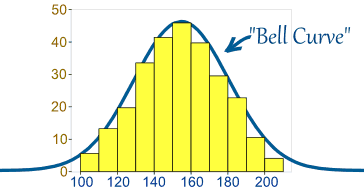
    Okay this is just cute, have a better graph

    "Laser"
    So imagine instead of 150 in the middle, it said 65%, this graph says
    that you scored 65% 45 times over the year, you scored at 64% 40 times,
    63% 32 times (or so) and so on. 

    The y axis is the frequency of tests. The x axis is your score. Right under the middle of the ghost's head, is 65%, to the left is the 50s and the right is the 70s. Most of your scores are at/near the 65% mark and then they taper down. This means that over the course of the year, you probably scored a whole lot between 63 and 67 if your average score is 65%, but you scored less frequently over the year at 60 and 70. Even less at 55 and 75. It's unlikely that you scored 50% or 80%.

    So yeah, sometimes, you'll score 65%. Other times, you'll have a bad day, maybe your timing was off or maybe your horse picked up the wrong lead. All normal mistakes for your level of training, but a combination of all of your minor issues led you to earn a 56%. That's unfortunate. But then one day you have a great test, everything falls into place, you make no mistakes, your horse is feeling good, and you get a 74%. Then you have a pretty good test and that drops to 68%. Then you have another not too great one and it drops down to 62%.

    Maybe one day we'll think that a bad score is 62 haha

    Over and over you ride this test. By the end of a year, you're bored to death (but the judge is still happy since we held that constant, maybe we should have held your happiness constant so you wouldn't complain so much), but you have an excellent understanding of where you stand. Your high score of 74% and your low score of 56% don't necessarily define your current ability (perhaps your ability on a really good day or a really bad day), your average score of 65% does.

    But not very many of us have the means to ride the same test 365 times just to see where we're at. In addition, we are constantly trying to improve ourselves, showing at different venues, showing in different footing, showing under different judges, having minor and major setbacks due to injury, sickness, etc. So how do we really know how we're doing? We have to kind of guess based on our scores, and back to my original point, our rides.

    So much of this sport is guessing, like guessing what color this
    weird horse is

    Alright, so back in the real world, you go out to a show and score 76%. Holy shit! You're AMAZING. At your next show, you score 65%. Oh... what a let down in comparison. Also, evidence for anchoring, where you hold onto the first piece of information you receive but we're not talking about psychology right now.

    BUT, without riding all those hypothetical tests, we don't know what our normal distribution is (and yes I mean it could be NOT a normal distribution, THE HORROR) and we have no idea what our average is. Perhaps we had an extreme score on that first ride. Just a totally randomly high score, great, but probably not reflective of where we really are, we're really closer to 67% maybe, or 65%.

    Perhaps though, we had an extreme score on our second ride, an extremely bad score (who calls a 65% a bad score?? Perhaps someone who normally scores 76%?), and that the 76% is actually where we stand. How do we know? We just need to show more! But what about all those nuisance variables? I... I... why isn't the real world like a laboratory?!

    Please do not put me in a laboratory

    So anyway, having good and bad rides always makes me think about this. Every time I have a good ride with TC, I can't tell whether we're having a ride that would be considered an outlier- a particularly good ride that isn't any indication of where we are, it just happened by chance OR whether we're actually progressing. Only over time, by riding that damn test every day (or, you know, being a normal person and just riding) will it become apparent whether that day was indicative of where we were at or whether it was just a chance good day.

    And by the time we realize what that particularly good ride was, we've probably had another particularly good or bad ride that we were left guessing about. Riding horses is fun!

    And ponies make statistics better!

    By the way, if anyone had trouble with the way that statistical tests work and for some reason feel like learning a bit more now, keep reading! Statistical tests are designed to calculate whether or not your horse scored that high due to chance, or whether it was because your horse is simply awesome (we kind of have to imply the awesome part).

    Let's say you want to know whether your horse is what we'll call an average dressage horse. Let's say you think that an average dressage horse's scores will be 65%, so you put that in the middle of your distribution. You then take your horse to a dressage show and score 80%. Is your horse an average dressage horse that had a great test? Or an above average dressage horse who had a decent test? You can calculate the chance that you, on a horse you assume scores 65%, will score excessively high, like 80%. Perhaps that happens only once in every hundred tests that you ride if you are truly riding a 65% horse.

    BUT that score is so high that since you actually managed to score it, you're starting to think that maybe you're not on an average horse. I mean, what horse who normally scores 65% scores 80% just randomly? It'd be more plausible that your horse ACTUALLY has an average score of 75%, where it'd be a lot more plausible to score 80%.

    There's only a 1% chance that a 65% horse will score 80%, but there's a much higher chance that a 75% horse will score 80%. So, when your presumed 65% horse scores 80%, it's probably not a 65% horse.

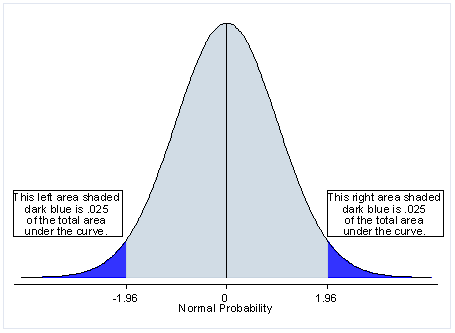
    p = .01

    Statistical tests won't tell you whether your horse is indeed a 75% horse, but they will tell you that it's so highly unlikely that your horse is a 65% horse, that you can conclude that your horse is NOT a 65% horse.

    We can basically say that if you score in the dark blue regions,
    you probably just drew the graph wrong rather than have a horse
    that scores at 65% score 80% because the odds are so low


    This also applies to treatment effects. Say you have a current 65% horse, you apply training (treatment), then you test the horse again and they score 80%. Because it's so highly unlikely that a 65% horse would score at 80%, you can conclude that your training produced a statistically significant improvement in the horse's scores.

    p = .01

    Thursday, September 10, 2015

    Blog Hop: Challenges

    Yesterday I drove nearly 3 hours round trip to ride my horse for 10 minutes in 100 degree heat. That's how much I needed to ride a pony after work I guess (also it was in the 80s at work). This week sucks. But I won't go on about it.


    I'm super excited for this blog hop/contest that No Hour Wasted has going on.

    Tell me about a challenge you set for yourself and accomplished, or set yourself a new challenge and keep us updated!

    The most recent blog-hop-worthy challenge I set and accomplished for myself was earning my USDF Gold Medal on my own horse, who I've had since he was a gangly Training level horse. This accomplishment is well documented on this blog, but since it is basically the best thing I've done, I do want to go through it yet again.

    BUT I want to focus on the thought process I took through it so I can learn about my own ability to set goals for myself. Try to dissect that. Because this goal, while always a goal for me personally, was never a goal for Rico. At what point did that changeover happen? How does knowing what I know now change my goals for TC?

    Current goals: to make moments like this happen all the time.
    Also to stop doing whatever my left hand is doing.

    When I first got Rico, Prix St George was my major goal. I'm not sure why Grand Prix wasn't there. Possibly because I was a First level rider and so to me, PSG and GP seemed so similar at the time. Maybe it was because I didn't know that Rico would be capable of it. I think the main reason was that it seemed so impossible, as that level always feels when you're struggling to steer your horse.

    Looking back, it's kind of silly to think that he didn't have the potential. But I know that this is just my natural creeping determinism (hindsight bias) kicking in, since there were so many reasons why it wouldn't have happened. But there were so many reasons why it did. Rico is a nice horse, nicer than anything I'll have for a long time. He handled stress and pressure well. While not necessarily easy to ride at the lower levels, he had a talent for piaffe and passage that was apparently a little unusual. The reason why he went from first learning pi/pa to showing Grand Prix in under a year.


    Schooling 4th in April-ish 2013

    Schooling Grand Prix in April-ish 2014

    So not only was it possible to get this medal on Rico, I also achieved this long term goal of mine in much less time than I thought. Knowing this, it makes me wonder about TC. What does this mean for my current goals (3rd with PSG as a maybe) with TC? How does this affect my ability to plan and make goals after the fact? Do I embrace that this was probably a freak thing and make reasonable goals for TC? Or do I throw all reason out the window?

    So for today I've gone back through my blog and tried to figure out my thought process. When did Grand Prix become something I even mentioned on this blog? When did it become even an unreasonable goal? When did it become a reasonable goal?

    Also what should I have noticed? What were the predictors for making it to Grand Prix on Rico? And using these, how can I better predict the future with TC?


    But let's back up, before our foray into the FEI levels, before I ever did a successful canter pirouette on him. You guys have recently heard about how injury prone he was, and in September 2009 he was laid up for a year and a half due to a lesion in his DDFT. Prior to that, we had showed Third level successfully and had barely gotten our two Silver medal scores at 4-1.

    4-1, ignore the top hat, it has since been retired

    In 2010 and early 2011 I showed Leo, my trainer at the time's previous Grand Prix horse. I showed him PSG, earning my Silver, then showed I2 twice, earning two scores toward my Gold, then showed Grand Prix before Leo retired to the lower levels. I knew I had two more scores at Grand Prix to earn, but I no longer had any sort of FEI horse, so I put that goal on my bucket list and hoped that one day I'd have enough resources to lease another GP horse or buy a nice horse and go into training.

    April 2011, as Leo was bumped down to the lower levels, I started riding Rico bareback (I had sold my saddle), just for fun. I didn't make any plans for him, I just wanted to enjoy my horse. I was quite superstitious (a lot of that was a joke but some was real haha) about bringing him back. I thought that if I got him ready to show, he'd just turn around and go lame again.

    Leo ft my inability to keep my right butt cheek on
    the saddle in pirouettes

    Our first ride back togethe

    So he didn't have a bridle path, a pulled mane, or a saddle for a few months. Slowly I snuck up on him. I gave him a bridle path one day, just telling him that it'd be more comfortable for his fly mask. Then I bought a saddle, but a cheap one. And I didn't have stirrup leathers for a while so I rode without stirrups. Slowly he became a dressage horse again. And then he went lame. But it was his check ligament and it was just a strain, so we pushed forward.

    At the end of 2012, we showed 4-1 again and kind of failed. It was a 62 and change. I went off course. But I was super stoked that we were back! After his DDFT, my vet said that he couldn't know what Rico would be capable of doing, there were only a few documented cases of his injury. Some horses came back, some didn't. So I was pleased that he returned to the same level.

    Please put your fucking hands down

    I still tilt that way to this day, but at least my hands have lowered

    Early 2013 I was having issues with Rico in the connection. I had saved enough money by then to afford a lesson, so I sought out Tracey. I mostly had Prix St George on my mind. I wanted to return to the FEI levels. So many of my blog posts from around that time center on that damn test.

    Tracey made me realize that I had to take a step back and look at the quality of the gaits, quality of the connection, and to stop fucking pulling on that left rein. I can firmly say that my work with her for what would be the next year and a few months is why TC is coming along so nicely. She is adamant about the basics. I can now feel SO much more, I have higher standards.

    Over the next few months with weekly lessons (she never rode him), Tracey helped me fill in a lot of the holes that Rico had in his training brought to you by yours truly. I still didn't think about Grand Prix. I have a bit of a one track mind I guess. Tracey is also not the sort of person who puts crazy ideas in people's heads. Like taking a barely Fourth level horse to Grand Prix in a year and a half.

    First lesson with Tracey, it wasn't pretty
    PSG happened six months after that lesson (though this is a
    picture from his second PSG because for some reason I don't have
    pictures on here from our first)

    Prix St George did happen that year, September 8th actually. I still had no idea that I'd be showing Grand Prix in 364 days. It wasn't yet on my radar.

    That fall I showed PSG a few times. I decided that I'd try for some awards the next year, maybe do I1 at the end of the year. In November I rode with Alfredo Hernandez. This is the first time that the words Grand Prix fluttered through my blog posts.

    But even that winter when I did my yearly goals, I didn't think I'd make it to Grand Prix in 2014. I actually thought that going I2 was a crazy reach goal. Looking back I'm like of course I'd make it, what, do I not believe in myself? Hindsight bias.

    I continued just letting it roll around in the back of my brain in the spring. I got injured, Rico got ulcers and had behavioral problems. It was all just kind of blah that spring. I don't see myself mentioning Grand Prix very often in my posts, and when I do it's still just a pipe dream.

    In June, Alfredo gave me another huge boost toward Grand Prix and put it in my mind again. It stayed there, which caused problems with my relationship with my trainer, who didn't want to push us to that level. I realized my finances would mean that I couldn't afford to keep Rico going very much longer. We had a bad lesson and I changed trainers.

    Piaffe

    Heidi saw me for the first time and was confused about why Grand Prix wasn't happening yet. I was so excited, that post is so happy, I love reading it. I can tell you that having a trainer who is a combination of very talented at taking riders to the level I wanted to be AND who firmly believes in me was amazing. Don't let this make you think that I don't have the utmost respect for Tracey though, she fixed us, but sometimes having fresh eyes is very helpful.

    From then on, we were on the fast track to Grand Prix. I started riding with Heidi in July, we showed Intermediare II in August, did our first Grand Prix in September, and earned my Gold in October.

    Passage in our first Grand Prix

    Looking back, there's a lot to learn from this, both about myself and about how I make goals. Here were some of my takeaways:

    1. It's really hard to predict how things will go, but deliberately holding myself back because I didn't think Grand Prix was possible on Rico only hurt my ability to train him to that level. Not putting piaffe and passage on him earlier in life, not working on the quality of the gaits, not working on the connection. Those slowed us down (not by much apparently haha but we had a lot of catch up to do in the last year).

    2. The basics were what got us there. My lessons were all about forward and connection, about fixing my bad habits. They were not as often about the biomechanics of piaffe, passage, or pirouettes except when they were breaking down due to forward or connection. It took maybe one lesson to get me doing those movements better. It took what felt like thousands of lessons to get Rico through and responding to my leg. The biomechanics only ever broke down when Rico was behind my leg.

    3. Related to both of these, having a trainer is essential if/when I feel like I'm unable to keep myself on the right path. It's easy to say to myself that I'm a trainer, I've taken a lot of horses from TC's level up the levels, I don't need a trainer right now. And I don't. But I will need one soon. Because I'm not looking at riding at the lower levels, where I'm comfortable training, I want to wear that fucking shadbelly again.

    The best
    Based on what I've learned from this, I need to stop being so reasonable. Ahaha that's such a horse person thing to say.

    So this is me, right here and right now, shoving my reasonable goals for TC out of my way. It's reasonable to think that he will go to Third level. It's even slightly reasonable, but also quite unreasonable, to think that I could get him to Prix St George. But thinking in terms of reasonable goals stifles my training, as shown above with Rico. The second I started thinking unreasonably that I wanted my Gold, everything fell into place.

    But it's hard to look at TC and think that Grand Prix is a possibility. There are just so many more ways that it could fail than succeed. If I do make it a goal and don't achieve it (which, let's face it, is probably going to happen), then I'm stuck having to admit that my prediction failed, that I'm not as good of a trainer as I thought, that TC wasn't as good of a horse as I thought. And that never feels very good. It's easier to lowball myself and be pleasantly surprised when I succeed.

    But studies have shown (I'm at work so can't look up articles but this ted talk is a digestible source) that people who make unreasonable/optimistic goals and fail are happier and feel better than people who expect less of themselves and do better than they expected. In addition, the anticipation of the unreasonable goal increases happiness right now regardless of whether it is going to happen or not.

    I go back and forth between being like WOW he has a lot of
    potential

    And uhhhhh maybe not
    Despite feeling completely delusional to think that this little weirdo may go to Grand Prix, if I don't make that a goal, if it's not in the back of my mind that he could go that far, the path that I take with him will not be the right one.

    If I've got it in my mind that he'll only go to First level, I won't insist that he learns to collect well. If I only think he'll go to Second, I wont bother putting quality changes on him. If I don't think he'll go to Fourth, I won't bother with pirouettes. If I don't think he'll make it to PSG, I won't put a good zig zag on him. Being reasonable about my goals with him will stifle his training, and I don't want to do that.

    So my new goal with TC is to get him to Grand Prix. It's not a goal that I think is all too achievable, it's not a reasonable goal given his conformation and natural way of going, but it's a goal that will allow me to be the best trainer I can be. I want him on that trajectory. And if we fall short, I'll have a HELL of a First/Second/Third/etc level horse one day.

    At least I'm learning and growing as a rider, even on such a green
    little horse