I used to have a love-hate relationship with leg yields. They're so damn helpful and the gateway to the rest of the lateral work, but ugh straightness ugh crossover ugh roundness. I've done enough of them now to not hate them (and now all of my lateral work hatred is focused on half pass).
 |
| Oh hey Intermediare II half pass. I HATE YOU. |
A leg yield, for those who may be unfamiliar, is a lateral movement where the horse stays straight (parallel to the long side of the arena if leg yielding from centerline to rail or rail to centerline) with a slight lateral flexion (lateral flexion = at the poll*, bend = through the whole body). Both the inside front legs and the inside hind legs cross over as the horse leg yields. Leg yield can be done at all three gaits but no crossover occurs at the canter and horses may interfere at the canter. I don't typically leg yield at the canter unless a trainer makes me. I've never had it really help much.
*saying flexion at the poll doesn't make sense because the horse's vertebrae don't work that way, the horse flexes longitudinally at the atlas/poll and laterally one joint down at the axis.
 |
I literally have no pictures of me doing
leg yield so enjoy some from google! |
I generally try to get leg yield on a horse as soon as I possibly can unless the horse is particularly squirrely and might use it against me. But in general, having more control over the horse laterally is a good thing.
My typical precursor to leg yield is turn on the forehand, mostly because it isolates the hind legs from the front legs and is usually easier for a horse to understand and perform correctly than a leg yield. Plus, IMO, it's nice to introduce lateral work with a movement that you'll never be asked to do in a dressage test so you can do it real shitty and never have to worry.
Once as I have turn on the forehand in both directions from a light aid, ideally while the horse is softly on the bit and not yanking my arms out (TC's first turns on the forehand were basically pony wrestling), then I'll start the leg yield.
There are a lot of different ideas of how to put on a leg yield and where to do leg yield and when to introduce leg yield to your parents. Lots. Here are some that I have heard that I don't totally disagree with:
- always leg yield from rail to centerline so the horse doesn't learn to rush to the rail
- starting the leg yield from centerline to the rail because most horses want to be on the rail and that can help you install it
- always make sure the horse is totally straight in all aspects of training the leg yield, even if the crossover is not that great, the crossover will come later
- always make sure the horse is crossing over in all aspects of training the leg yield, even if the straightness is not that great, the straightness will come later
- don't ever leg yield along the fence because the horse will get tense
- start the leg yield along the fence because the rail will help keep them in balance
Soooo yeah. I tend to make decisions based on the horse I'm on. If I'm on a horse that gets tense when pushed against the rail, no leg yield along the rail. If I'm on a horse that gets very crooked while riding in straight lines, go for straightness before crossover. And I think a horse rushing to the rail is more of a rider problem (as in, rider lets horse ooze to the rail and doesn't correct rushing) rather than a horse problem.
 |
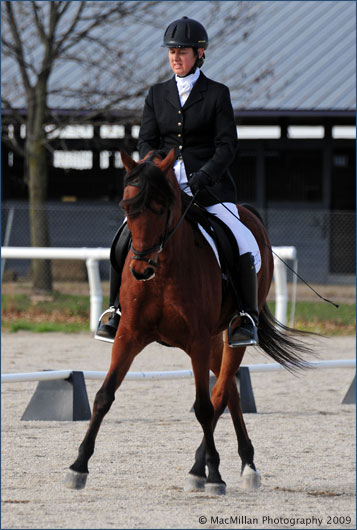
| A little more flexion than my taste but love the free shoulder |
There's also a lot of information about where the rider should sit. I do have a strong opinion on that. People always say "sit to the inside of lateral movements" and "sit to the outside of lateral movements" and "bring your inside shoulder back" and "put your outside shoulder back" and "look where you're going" and "look to the inside."
I have had the best luck sitting in the middle of the horse, or if you put a gun to my head and told me to pick a side (why would you do that?!) I would say sit to the inside. But really, even weight in both seat bones is the way to go because people take "sit to the inside" way too far. I tend to want riders to sit totally straight, both shoulders perpendicular to the rail/facing C, and looking straight ahead. First- this is a good way of getting out of the way of the horse. Second- this is a good way to feel any not-so-straight moments that your horse throws at you.
There are also a lot of ideas of where the leg should be and what the reins should be doing. Honestly, in the beginning I tend to believe that where you *should* put your aids is wherever your horse needs them. But I like the horses to be even in both reins, with my outside rein not resting against the horse's neck (stop it! stop that now! I see it so much!) and my inside rein not open or crossing over the horse's neck. As for my hands, I don't do much with them, but the connection should be good enough where you can half halt on each rein or both and have the horse respond accordingly.
Legs-wise, I like the leg yield to come off of an inside leg that is very slightly behind the girth. I always made the mistake of putting my leg too far back and Heidi would yell at me (this was years ago) that my legs were too long to put my leg that far back because she (who is 5' to my 5'6) wouldn't be able to ask the horse. I also think it risks getting the horse leading with the haunches too much. Outside leg shouldn't be kicked away from the horse. Outside leg sends the horse forward and balances the horse, so outside thigh is there to support and outside calf is there to regulate the sideways.
In general- the less you can do and still get a leg yield, the better.
 |
| Someone steal me this horse |
So you're putting on leg yield and having problems. The first thing I always have to remind people is this: horses are not machines, leg yields require flexibility and not all horses are masters of horse yoga. Even if your horse is already trained, if they haven't done it in a while, leg yields still require flexibility and without regular practice, flexibility goes away. I had a student who had a horse who was terrible at leg yields and so she would never practice them outside of lessons when I would teach her (and lecture her about practicing). News flash! The horse was bad at leg yields because she never practiced them!
For example, Rico can leg yield like a pro, but if I were to ask him to do it right now, after months off of lateral work, he would really struggle. It doesn't mean I'm doing anything wrong, it doesn't mean he is doing anything wrong, it means that he needs to do more horse yoga in his pasture.
For the laterally challenged horse, such as TC, I love introducing leg yield along the rail after the turns on the forehand are acceptable. Leg yielding on the rail helps to isolate the crossover and will prevent rushing forward to avoid crossing over. I start with a few steps here and there, then work up to the whole long side. Once as I get a slight angle off the rail, then I start getting the angle steeper (add inside-to-the-leg-yield leg and outside-to-the-leg-yield rein) for a few steps at a time.
After that, I start playing with them from centerline to rail and rail to centerline. For a horse that struggles with going sideways, I emphasize crossover first and deal with straightness later. So at this point, TC gets a little overbent sometimes, he'll eventually stop that. I don't want to ever punish this horse for crossing over, or put him in a place where he can't be successful (he knows I want him to go laterally over THERE but he can't do it if I constantly block him on the outside rein and don't let him move over). Tension is the enemy in lateral work.
 |
| Leg yield along the rail |
Once as he understands the concept and feels confident, then I'll start work on the straightness. As I said above, with a horse who seems overly enthused about lateral work, I typically work on straightness first, then develop crossover within straightness. There are two things (okay there are more but there are two that I've found to be the most helpful) that affect the straightness in the leg yield.
1.) Connection. If the horse refuses to connect to a rein, over connects and bulges through a rein, or anything in between that isn't a good connection, you'll likely have a straightness problem. You may have it because as you leg yield to the right off the left leg, the horse bulges through the right side and the haunches trail. You might have it because the horse refuses to connect to the left rein, so ends up flexed the wrong way when leg yielding to the left off the right leg. Fix the connection on the straightaway/circle and the leg yields will be easier.
2.) Straightness. Duh. But a horse that is crooked when you turn down centerline isn't going to magically straighten out when you start asking them to cross their legs over. Think of a crooked horse like a kinked pipe cleaner. You can't make them straight by trying to make them crookeder, you need to grab their nose and their tail and yank pretty hard, then flex them and ask for leg yield.
While all of this is happening, I work on the roundness. Some horses find this easier than others. TC goes rounder when doing lateral work most of the time, which is awesome. Rico thought that lateral work was easiest done with his face straight up in the air.
Hollowness leads to tension and as I said above, tension is a leg yield (and lateral work) killer. Leg yields require the horse to be soft through the back so they CAN crossover. You always see it, right? A horse who isn't crossing over enough because they are tense being smacked by a rider who demands that they crossover more when the best thing they can do is just bring it back down to the basics and get the horse to chill a bit...
It's hard. But see above- teaching the horse to stay on the bit in the turn on the forehand is very helpful. It's an easier movement, you can isolate the hind end crossover and associate that with roundness and connection on the outside rein.
Once as I have that, I usually start the leg yield in walk on the bit. When the horse comes off the bit, I circle 10 meters to the inside to put the horse back on the bit, then start the leg yield again on the bit. The hardest part for my students has been counteracting the desire to make it to the rail or wherever your arbitrary end point is.
Say you start on centerline heading to the rail and the horse gets hollow on quarterline so 10m circle to fix it, back toward the rail and a few steps later the horse is hollow again. But ugh you're so close to the rail and you're running out of room and blah blah so you don't circle and instead, the horse gets hollow, braces against the outside rein or bulges through it, and dumps onto the rail. That moment RIGHT before the rail is so important. Abandon ship when things go wrong, don't let the ship slam laterally into the rail.
From there, I introduce the leg yield zig zag (helpful for horses who "take over" in the leg yield) and nit pick at the first and last steps of the leg yield. Having a good first step and a clear ending to the leg yield really wraps it up like a package and makes judges happy.
There's so much more I could say, but this post is long and I'm running out of decent leg yield pictures from google.
Two things from today:
I rode TC today and he was great, especially the quality of the canter! Also his sister is trying to kick the shit out of their mom which is hilarious, she's three days old.

.jpeg)


.jpeg)


.jpeg)


.jpeg)
.jpeg)
.jpeg)
.jpeg)
.jpeg)
edit.jpg)
edit.jpg)

edit.jpg)
edit.jpg)



.jpeg)
.jpeg)
.jpeg)
.jpeg)
.jpeg)